How to Read Donald Duck : Imperialist Ideology in the Disney Comic
 | |
| Author | Ariel Dorfman Armand Mattelart |
|---|---|
| Original title | Para leer al Pato Donald |
| Translator | David Kunzle |
| Country | Chile |
| Language | Spanish |
| Publication date | 1971 |
| Published in English language | 1975 |
How to Read Donald Duck (Spanish: Para leer al Pato Donald) is a 1971 book-length essay by Ariel Dorfman and Armand Mattelart that critiques Disney comics from a Marxist bespeak of view as capitalist propaganda for American corporate and cultural imperialism.[1] [2] It was first published in Chile in 1971, became a bestseller throughout Latin America[3] and is all the same considered a seminal piece of work in cultural studies.[4] It was reissued in August 2018 to a general audience in the United States, with a new introduction past Dorfman, past OR Books.
Summary [edit]
The volume's thesis is that Disney comics are not but a reflection of the prevailing ideology at the fourth dimension (capitalism), merely that they are also aware of this, and are active agents in spreading the ideology. To exercise so, Disney comics use images of the everyday world:
-
"Here lies Disney'south inventive (product of his era), rejecting the crude and explicit scheme of adventure strips, that came up at the same fourth dimension. The ideological background is without whatever dubiety the same: but Disney, non showing whatever open up repressive force, is much more unsafe. The sectionalization between Bruce Wayne and Batman is the projection of fantasy outside the ordinary earth to salvage it. Disney colonizes the everyday world, at hand of ordinary homo and his common problems, with the analgesic of a child's imagination".
—Ariel Dorfman and Armand Mattelart, How to Read Donald Duck, p. 148
This closeness to everyday life is so just in appearance, considering the earth shown in the comics, according to the thesis, is based on ideological concepts, resulting in a set of natural rules that pb to the acceptance of particular ideas about capital, the developed countries' relationship with the Third World, gender roles, etc.
Every bit an case, the book considers the lack of descendants of the characters.[v] Everybody has an uncle or nephew, everybody is a cousin of someone, but nobody has fathers or sons. This non-parental reality creates horizontal levels in guild, where there is no hierarchic order, except the one given by the amount of money and wealth possessed by each, and where there is almost no solidarity amid those of the same level, creating a situation where the only matter left is crude competition.[6] Another issue analyzed is the absolute necessity to have a stroke of luck for social mobility (regardless of the endeavor or intelligence involved),[vii] the lack of ability of the native tribes to manage their wealth,[eight] and others.
Publication history [edit]
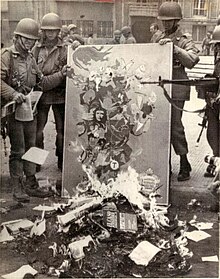
Soldiers burning books in Chile, 1973.
How to Read Donald Duck was written and published during the brief flowering of democratic socialism under the government of Salvador Allende and his Popular Unity coalition and is closely identified with the revolutionary politics of its era.[9] In 1973, a coup d'état, secretly supported by the United States, brought in ability the military dictatorship of Augusto Pinochet. During Pinochet'southward regime, How to Read Donald Duck was banned and field of study to book burning; its authors were forced into exile.[ix]
Exterior Chile, HtRDD became the most widely printed political text in Latin America for some time.[3] It was translated into English, French, German, Portuguese, Dutch, Italian, Greek, Turkish, Swedish, Finnish, Danish, Japanese, and Korean[ten] and sold some 700.000 copies overall; by 1993, it had been reprinted 32 times by the publisher Siglo Veintiuno Editores.[11]
A hardcover edition with a new introduction by Dorfman was published by OR Books in the United states of america in October 2018.[12]
Reception [edit]
Thomas Andrae, who has written about Carl Barks, has criticized the thesis of Dorfman and Mattelart. Andrae writes that it is not true that Disney controlled the work of every cartoonist, and that cartoonists had nearly completely complimentary easily unlike those who worked in blitheness. According to Andrae, Carl Barks did not fifty-fifty know that his cartoons were read outside the United States in the 1950s. Lastly, he writes that Barks cartoons include social criticism and even anti-capitalist and anti-imperialist references.[13]
David Kunzle, who translated the book into English, spoke to Carl Barks for his introduction and came to a similar conclusion. He believes Barks projected his ain experience as an underpaid cartoonist onto Donald Duck, and views some of his stories every bit satires "in which the imperialist Duckburgers come off looking equally foolish as—and far meaner than—the innocent Third World natives".[14]
References [edit]
- ^ "How to Read Donald Duck: Imperialist Ideology in the Disney Comic". Pluto Press. March 2019.
- ^ Lazare, Donald (1987). American Media and Mass Civilization: Left Perspectives. University of California Press. pp. 16–17. ISBN9780520044951.
- ^ a b Jason Jolley. Ariel Dorfman (1942–). The Literary Encyclopedia (2009)
- ^ "Kaalgeplukt en doorgekookt: Ariel Dorfman over Donald Duck". De Groene Amsterdammer. i July 2009.
- ^ Dorfman A., Mattelart A. Para leer al pato Donald p. 23. 1983. As well the lack of descendants, at that place is a consummate lack of libido or sexuality. The quote at the get-go of this chapter is remarkable:
- "Daisy: If you teach me how to skate this afternoon I'll requite y'all what you lot have ever wanted.
- Donald: Do you mean...?
- Daisy: Yes... my 1872 coin"
- ^ Dorfman A., Mattelart A. Para leer al pato Donald p. 35. 1983.
- ^ Dorfman A., Mattelart A. Para leer al pato Donald p. 139. 1983.
- ^ Dorfman A., Mattelart A. Para leer al pato Donald p. 53. 1983.
- ^ a b Tomlinson (1991), p. 41–45
- ^ McClennen (2010), p. 245-279
- ^ Mendoza, Montaner, Llosa (2000), p. 199–201
- ^ "How to Read Donald Duck". OR Books . Retrieved 27 August 2018.
- ^ Andrae, Thomas (2006), Carl Barks and the Disney Comic Book: Unmasking the Myth of Modernity, Univ. Press of Mississippi, ISBN1578068584
- ^ David Kunzle. "The Parts That Got Left Out of the Donald Duck Book, or, How Karl Marx Prevailed over Carl Barks." ImageText vi(ii).
Sources [edit]
- Andrae, Thomas (2006), "Rereading Donald Duck", Carl Barks and the Disney Comic Book: Unmasking the Myth of Modernity , University Press of Mississippi, ISBN978-1578068586
- Constantinou, Costas Grand. (2008), "Communications/excommunications: an interview with Armand Matellart", in Constantinou, Costas Thousand.; Richmond, Oliver P.; Watson, Alison Thou.Southward. (eds.), Cultures and Politics of Global Communication: Volume 34, Review of International Studies , Cambridge University Press, ISBN978-0521727112
- McClennen, Sophia A. (2010), Ariel Dorfman:An Aesthetics of Hope, Duke Academy Press, ISBN978-0822391951
- Mendoza, Plinio Apuleyo; Montaner, Carlos Alberto; Llosa, Alvaro Vargas (2000), "How to Read Donald Duck: Ariel Dorfman and Armand Matellart, 1972", Guide to the Perfect Latin American Idiot , Madison Books, ISBN978-1461662785
- Mirrlees, Tanner (2013), "Paradigms of Global Entertainment Media", Global Entertainment Media: Between Cultural Imperialism and Cultural Globalization , Routledge, ISBN978-1136334658
- Mooney, Jadwiga E. Pieper (2009), "Roasting the Duck:National Hegemony and Revolutionary Civilization", The Politics of Motherhood: Maternity and women's rights in twentieth-century Republic of chile , University of Pittsburgh Press, ISBN978-0822973614
- Smoodin, Eric (1994), "Introduction: How to Read Walt Disney", in Smoodin, Eric (ed.), Disney Discourse: Producing the Magic Kingdom , Routledge, ISBN978-1135216597
- Tomlinson, John (1991), "Reading Donald Duck: the ideology-critique of 'the imperialist text'", Cultural Imperialism: A Critical Introduction , Continuum International Publishing Group, ISBN978-0826450135
Farther reading [edit]
- Robert Boyd. "Uncle $crooge, Imperialist" Comics Periodical #138 (October 1990), pp. 52–55.
- Dwight Decker. "If This Be Imperialism..." Amazing Heroes #163 (April 15, 1989), pp. 55-57. An installment of the "Doc'south Bookshelf" column. Analysis by a prominent comic volume fan and Carl Barks expert.
- Dana Gabbard and Geoffrey Blum. "The Colour of Truth is Greyness." Walt Disney'southward Uncle Scrooge Adventures in Colour #24 (1997), pp. 23–26. Disquisitional analysis by two experts on Carl Barks.
- How to Read Donald Trump: On Called-for Books just Non Ideas A 2017 essay by Dorfman.
- Dan Piepenbring (June three, 2019) The Volume That Exposed the Contemptuous Politics of Donald Duck. The New Yorker.
Source: https://en.wikipedia.org/wiki/How_to_Read_Donald_Duck
0 Response to "How to Read Donald Duck : Imperialist Ideology in the Disney Comic"
Post a Comment