How to Read a Topographic Map Worksheet
Types of profile lines: How to Read a Topographic Map? Common Topographic Map Symbols.
A topographic map is printed on a apartment piece of paper yet it provides a picture of the terrain and manmade features through the use of contour lines, colors, and symbols. Profile lines represent the shape and elevation of the land, such as ridges, valleys, and hills. Colors and symbols are used to correspond other features on the state, such equally h2o, vegetation, roads, boundaries, urban areas, and structures.
This chapter starts with tips on how to read the margins of a topographic map. So information technology describes how to interpret profile lines. Finally, it covers how to guess slope, aspect, acreage, distances, and percent contained using a topographic map

What is a topographic map?
Common Topographic Map Symbols:
A topographic map is a detailed and authentic illustration of homo-fabricated and natural features on the ground such as roads, railways, power transmission lines, contours, elevations, rivers, lakes and geographical names.
The topographic map is a two-dimensional representation of the Earth's three-dimensional landscape. The most frequently used topographic map is at a scale of one:50 000.

Reading a topographic map worksheet
Different maps serve dissimilar purposes. If you're trying to bulldoze from Bespeak A to Point B, a regular road map is a way to get. But if yous've strayed from the route, perhaps on a backpacking trek, you need to see the terrain and the contours of the land. And that means you need to be able to read a topographic map.
Mutual Topographic Map Symbols: What's the departure between a topographic map and a regular map?
In a nutshell, topographic maps allow you to meet a three-dimensional landscape on a 2-dimensional surface. These maps show the land'south contours, elevations, mountains, valleys, bodies of water, vegetation and more. This contour and pinnacle information distinguishes them from other maps.
Types of contour lines
The power to fuse these major factors is the virtually critical skill one tin larn when using a topographic map. The primary purpose of a topographic map is to accurately stand for the shape of the World's surface, only the utility doesn't stop there. Topographic maps also represent streets and trails, vegetation, streams, and every type of feature that may positively or negatively impact your ability to navigate through the terrain.
Contour lines on a map
Mutual Topographic Map Symbols: Contour lines are imaginary
They are map artifacts used to represent paths or segments of Earth at an equal summit. These paths and segments are presented as elevations (vertical distance to a higher place or below bounding main level) and reliefs (the shape of terrain features on the Earth's surface).
Not all profile lines are created equal. Heavier contour lines are known as indexed contour lines and are normally numbered showing elevation. Typically every fifth contour line is an index.
Lighter contour lines, that fall between indexed lines, are known every bit intermediate contour lines. These lines practise non accept their elevation given and are found in sets of four between indexed profile lines.
Finally, when the terrain is expansively flat, cartographers will ofttimes include supplementary contour lines, which are dashed lines indicating an elevation that is half of the elevation between the contour lines surrounding it. They are typically found where in that location is little alter in tiptop.
How to read profile lines
Contour lines bespeak the steepness of the terrain. Contour lines connect points that share the same summit: Where they're close together (they never intersect), the meridian is changing chop-chop in brusque distance and the terrain is steep. Where contour lines are wide apart, the superlative is irresolute slowly, indicating a gentle slope.
Contour lines also indicate the shape of the terrain. Roughly concentric circles are probably showing y'all a peek, and areas between peaks are passes. Studying a topo map of a familiar expanse is a groovy way to learn how to lucifer terrain features with the contour lines on a map.

Interpreting Contour Lines
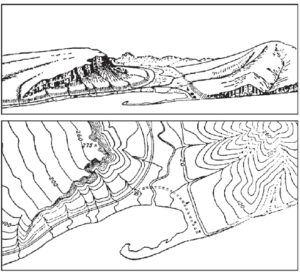
Contour lines on a map show topography or changes in elevation. They reveal the location of slopes, depressions, ridges, cliffs, the height of mountains and hills, and other topographical features. A contour line is a brown line on a map that connects all points of the same elevation. They tend to parallel each other, each approximately the shape of the ane in a higher place information technology and the i beneath it. Compare the topographic map with the landscape perspective.
Topographic map colors
Common Topographic Map Symbols: Information technology's important to know what kind of terrain and environment you're traveling into and what the map of that surface area is telling y'all.
The color brown is used to denote near profile lines on a map, which are relief features and elevations. Topographic maps use greenish to denote vegetation such as woods, while blue is used to denote water features like lakes, swamps, rivers, and drainage.
At higher elevations, mountains may be snow-capped yr effectually, or the terrain may actually be a glacier. In each of these cases, profile lines are likewise drawn in blue. Information technology is, therefore, possible to chop-chop discern that a detail route from A to B might be more than treacherous than operating at a loftier altitude—the expedition might require crampons, an ice axe, and other materials that might not be readily available once in the backcountry.
Finally, black is used to represent human-made objects, including trails. Red is used for man-made features, like main roads or political boundaries, and purple for new changes or updates on the map that weren't previously represented. Newer maps no longer apply purple, just since and so many older maps exist, it's worth mentioning.
Map scales
The map's scale tells you how detailed your map is. A 1:24000 scale, for example, means 1 inch equals 24,000 inches in reality. A larger scale, like 1:65,000, ways that a map covers a larger area, but that it will have less detail.
Maps besides have a representative scale to assistance y'all visualize real-world distances. You lot can employ this scale and a string or the border of your compass to get a rough estimate well-nigh hiking distances on your map. (Common Topographic Map Symbols)
Topographic map shading
The color similarity between features does not mean that the features are equivalent. Due north of Lake Raven is the Prairie Branch, another name for a stream. Other names that equate to a stream include kill, run, fork, and brook. What's interesting most Prairie Branch is that it has led to the formation of a wooded marsh or swamp.
Navigating beyond Prairie Branch could be difficult. Since this is Texas, look to run into water moccasins, copperheads, and perchance the occasional alligator, among all of the other friendly animals that phone call Sam Houston National Wood home.
Remembering map colors is a adequately trivial job, only remembering the shadings is far more than hard given the sheer number of variations. For this reason, keeping the USGS Topographic Map Symbols–a mere 2 sheets of paper–backside your map tin be a lifesaver. A quick reference to page iv of the booklet confirms that Prairie Branch is indeed a submerged wooded marsh or swamp. (Common Topographic Map Symbols)
Latitude and longitude map
Latitude and Longitude (edges of map): Common Topographic Map Symbols
Latitude and longitude lines are indicated with fine black tick marks along the edges of the map. Topographic maps do non show the latitude/longitude lines – just the tick marks.
The numbers next to the tick marks indicate degrees (°), minutes (') and seconds (").
On 1:24,000 scale maps, breadth, and longitude tick marks are indicated every 2.5 minutes.
- Longitude tick marks are on the superlative and bottom edges of the map and latitude tick marks are on the correct and left edges. Annotation that the degrees may be left off (as an abridgement) and you may only see the minute and/or second designations.
- Reference coordinates for breadth and longitude (degrees, minutes, and seconds) are black and located on the four corners of the map.
- The intersection of breadth and longitude lines are noted by cross-marks.
When reading breadth/longitude, pay close attending to the units (degrees, minutes, seconds) because information technology is easy to misread them. Refer to Chapters 3 and 6 for additional information on latitude and longitude.
What is a profile interval?
Contours maps (such as topographic maps) compress the data of a function over a two-dimensional area into a discrete set of closed lines that connect points of equal value (isolines), hit a fine rest between expressiveness and cerebral simplicity.
They permit humans to perform many mutual-sense reasoning tasks about the underlying part (e.g. acme).
The contour interval is the deviation in elevation between two adjacent contour lines. On USGS maps, contour intervals are normally one, v, 10, 20, 40, and 80 feet. If the contour interval is not printed on the map, information technology can be calculated.
Common Topographic Map Symbols
What exercise the contour lines correspond?
In cartography, a contour line (often simply called a "contour") joins points of equal meridian (superlative) to a higher place a given level, such as mean sea level. A contour map is a map illustrated with profile lines, for example, a topographic map, which thus shows valleys and hills, and the steepness or gentleness of slopes.
How do you lot read contour lines on a topographic map?
Topographic maps also have a vertical scale to allow the decision of a point in three-dimensional space. Contour Lines: Contour lines are used to make up one's mind elevations and are lines on a map that are produced from connecting points of equal acme (elevation refers to summit in feet, or meters, higher up ocean level).
What do the numbers mean on a topographic map?
The numbers represent the acme, the higher the number the college y'all are. Ordinarily, information technology's in something like meters or feet above sea level, check the key/legend (UK/U.s.a.!) which should tell yous exactly what. The closer together the lines, the steeper the terrain, the further they are apart, the shallower.
How do y'all read a topographic map calibration?
For example, if your U.S. Geological Survey (USGS) map has a calibration of ane:24,000, information technology means that i inch on the map is equal to 24,000 inches (2000 feet or 609.six meters) in the real world. Your map's scale legend will always be at the lesser. For USGS topographic maps, ane:24,000 is the scale nearly ofttimes used.

C-Map Contour
C-MAP, a leader in digital marine charting and cloud-based mapping, appear the next generation of C-MAP Contour charts, preloaded on sounders and plotters.

Types of Topographical Survey
While virtually people think of land surveys in the most basic sense—that is, the cartoon of the boundaries of property—there are actually many different ways of surveying that service many different industries.

Topographic Map definition
Topographic maps offer detailed information on a item surface area and are used for several types of activities such as emergency preparedness, urban planning, resource development, and surveying to camping, canoeing, adventure racing, hunting, and angling.
Source: https://www.gruasyaparejos.com/en/topography/common-topographic-map-symbols/
0 Response to "How to Read a Topographic Map Worksheet"
Post a Comment