All Things Must Pass Spine Art Edge First Issue
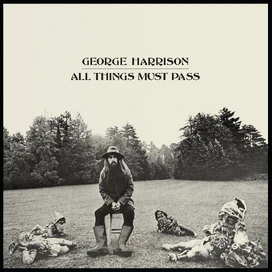
All Things Must Pass is a triple album by George Harrison recorded and released after the break-up of The Beatles. The outset triple anthology by a solo artiste, the original vinyl release featured 2 records of rock songs, while the 3rd, entitled "Apple Jam", was equanimous of informal jams led past Harrison with musician friends and other famous musicians.
It was eventually certified 6x Platinum by the RIAA.
Contents
- 1 History
- 1.one Background
- 1.ii Recording sessions
- ane.3 Reaction and backwash
- ane.iv 2001 re-release
- 2 Track listing
- two.i Original release
- two.two 2001 remaster
- three Personnel
- 4 References
- v Notes
History [ ]
Background [ ]
The outpouring of the wealth of cloth on All Things Must Laissez passer took many critics past surprise, with Harrison having long been overshadowed by the talents of John Lennon and Paul McCartney, despite the fact that some of his afterwards period Beatles inclusions ("While My Guitar Gently Weeps", "Something", and "Here Comes the Sun") were hailed as highlights of their respective albums. Consequently, equally Harrison had but been allowed a few songs on any given Beatles album, he had amassed many otherwise unused compositions by their pause-up, enabling him to release many of them on All Things Must Pass.
Harrison had been accumulating the songs he recorded for the album equally far back every bit 1966; both "The Art of Dying"[1] and "Isn't Information technology a Pity"[2] date from that year. In bootlegged chat from the Become Dorsum sessions, Harrison revealed that John had rejected "Isn't It a Compassion" 3 years earlier, and that he (Harrison) had considered offering the song to Frank Sinatra.[2] Harrison picked up several more songs in late 1968 while visiting Bob Dylan and The Band in Woodstock, New York. He and Dylan co-wrote "I'd Have Yous Anytime" and "Nowhere to Go" (likewise known every bit "When Everybody Comes to Town") at this fourth dimension, and Dylan showed him "I Don't Want to Practise It."[3] All three songs were attempted at some indicate in the sessions for All Things Must Laissez passer, but merely "I'd Have You Anytime" made the album.
The January 1969 "Become Back" sessions saw early appearances of several other songs that would exist considered for All Things Must Laissez passer, including the title track, "Hear Me Lord", "Isn't It a Pity", "Let It Downwards", and "Window, Window",[4] merely cypher came of them at the time. The tense atmosphere fueled another song, "Wah-Wah", which Harrison wrote in the wake of his temporary departure from the ring.[five] He began writing "My Sweet Lord" while touring with Delaney & Bonnie in late 1969,[6] and would subsequently utilise their bankroll grouping "Friends" as an of import part of the All Things Must Pass audio. He fabricated i terminal detour before beginning piece of work on All Things Must Pass, visiting Dylan while the latter was starting sessions for New Morning in May 1970, learning "If Not for You" and participating in a at present-bootlegged session.[seven]
Recording sessions [ ]
Recorded from May to August 1970 at Abbey Road Studios, and then further recording and mixing at Trident Studios from August to September 1970, Harrison enlisted the assistance of Phil Spector to co-produce the album, giving All Things Must Pass a heavy and reverb-oriented sound, typical for a 1960s/1970s Spector production — simply a audio Harrison would subsequently regret with the passage of time. In the electronic press kit that accompanies the 30th Ceremony reissue George is asked what he thinks of the anthology now 30 years after and he says, "...too much echo."
In late May 1970, before recording the anthology, Harrison saturday in a studio with Spector and ran through fifteen songs on guitar, with occasional support from an unknown bass player. These demos (eventually bootlegged as Beware of ABKCO! due to an altered line in his functioning of "Beware of Darkness") showed him in the process of weighing his material, as eight of the songs would be either substantially reworked or not appear on the finished album. Among these early on outtakes, iii accept been officially released in one form or another: "Everybody, Nobody" was an early on version of "The Ballad of Sir Frankie Crisp", "Beautiful Daughter" would exist finished for Thirty Three & 1/3, and "I Don't Want to Practice Information technology" would look fifteen years until being revisited for the soundtrack of Porky's Revenge. Five other songs, "Cosmic Empire", "Mother Divine", "Nowhere to Become," "Tell Me What Has Happened With Y'all," and "Window, Window", have not seen official release.[eight], along with other tracks such as "Gopala Krishna", "Dehradun" and "Cosmic Empire" that did not make the final cut.[9] 2 demos of songs that did make the album, "Beware of Darkness" and "Let It Down" (with overdubs from 2000), would eventually be released on the remastered All Things Must Pass. Full discs of electric outtakes from the recording sessions would too leak on bootlegs in later years, and some of those tracks were also included in the remaster. Multiple takes of songs from the album appear on a homemade three-disc box set The Making of All Things Must Pass along with other releases.
The album features the talents of Ringo Starr, members of Badfinger, Eric Clapton and the other members of Derek and the Dominos, futurity Yeah drummer Alan White, keyboard players Baton Preston, Gary Brooker and Gary Wright. A young, pre-Genesis Phil Collins played bongos on "Art of Dying", only was not credited on the original release (this was fixed on the 2001 remaster). Bob Dylan, a close friend of Harrison'due south, co-wrote "I'd Have You Someday" with him, while Harrison covered Dylan's "If Not For You lot", which had been recently released on Dylan's New Morning album. Alan White stated that John Lennon may take played on "If Not For You lot."[10] Though uncredited, Maurice Gibb was also present in the recording session having been friends with Ringo Starr, and played keyboards on "Isn't It a Pity", though in that location is no definitive evidence equally to which version. [eleven]
Bobby Whitlock recalls a very jovial and collaborative atmosphere at the sessions, as George Harrison "included everyone on everything he did considering there was enough for all."[12]
Reaction and aftermath [ ]
All Things Must Pass' lead single was "My Sweet Lord", which proved an enormously popular recording, reaching #i worldwide, and earned Harrison a copyright infringement conform from the publishers of The Chiffons'due south 1963 hit "He's So Fine" — a grievance that would non be settled for years. A estimate later on found that Harrison had unintentionally copied the earlier song; this prompted Harrison to later write "This Song". He also bought the publishing rights to "He's So Fine" to prevent future suits. The album itself reached #1 in the UK for 8 weeks, and spent seven weeks at the meridian in the U.Due south., where information technology was certified half dozen times platinum, making All Things Must Laissez passer Harrison's most commercially successful and generally best-loved anthology.
Anglo-Australian pop singer Olivia Newton-John'southward cover of Harrison's "What Is Life" reached the UK top twenty in 1972. (The year before, she reached the meridian ten with a cover of Dylan'due south "If Non For You", arranged similarly to Harrison's version; in the US, her version became her offset successful pop single, reaching #25. She would cover another vocal from All Things Must Laissez passer, "Behind That Locked Door").
A remastered edition of All Things Must Laissez passer, supervised by Harrison, was released in 2001, just months before his death; information technology contained bonus tracks, including a partially re-recorded additional version of "My Sweetness Lord". It too included a newly colourised version of the originally monochrome cover. With the original version of the anthology being concurrently deleted, the remastered edition of All Things Must Pass is the only commercially available version of the release.
On July 29, 2006, The Official UK Charts company changed their records because there was a postal strike when the album had originally been on the charts. At the fourth dimension, record retailers would send in documents maxim how many records had been sold, only because of the strike they could not during an eight-week flow in 1971. All Things Must Pass, which had originally peaked at number 4 (with Simon & Garfunkel'due south Bridge over Troubled Water at number 1), now has been given the number 1 spot for all 8 weeks.[13]
In 2003, the album was ranked number 437 on Rolling Stone mag's listing of The 500 Greatest Albums of All Time. The Guardian ranked the album on 9th place in magazine's listing of The Top 100 Albums That Don't Announced In All The Other Top 100 Albums Of All Fourth dimension.[14]
2001 re-release [ ]
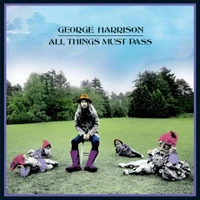
Re-release encompass
In 2000, George Harrison personally oversaw the remastering of All Things Must Pass — the beginning of a re-upshot project that was to see all his albums refurbished. Harrison lived long enough but to witness All Things Must Pass' re-release in January 2001 on his own GN Records imprint, distributed by EMI.
The re-issued CD version featured the original sepia anthology comprehend redesigned in color. Disc i contained the original vinyl sides one and two plus bonus material and disc two contained the original vinyl sides three to four with the "Apple tree Jam" tracks in a different order.
Harrison participated in Spider web chats and magazine interviews to promote the reissue. It was a large seller, reaching No. 4 in Billboard's Pop Catalog Chart too as sparking a critical reconsideration of Harrison's greatest work and solo career equally a whole. After Harrison'due south death in Nov 2001, the reissue returned to the upper regions of the same catalogue chart.
Rail list [ ]
All tracks written past George Harrison, except where noted.
Original release [ ]
Side i
- "I'd Have You Anytime" (Harrison, Bob Dylan) – 2:56
- "My Sweet Lord" – four:38
- "Wah-Wah" – v:35
- "Isn't It a Pity (Version One)" – 7:10
Side ii
- "What Is Life" – 4:22
- "If Non for You" (Dylan) – 3:29
- "Behind That Locked Door" – 3:05
- "Permit It Downwardly" – 4:57
- "Run of the Mill" – ii:49
Side 3
- "Beware of Darkness" – three:48
- "Apple tree Scruffs" – 3:04
- "Ballad of Sir Frankie Well-baked (Allow Information technology Ringlet)" – 3:48
- "Awaiting on You All" – two:45
- "All Things Must Pass" – iii:44
Side four
- "I Dig Beloved" – 4:55
- "Art of Dying" – 3:37
- "Isn't it a Pity (Version Two)" – iv:45
- "Hear Me Lord" – five:46
Side 5 (Apple Jam)
- "Out of the Blue" – 11:14
- "It's Johnny'southward Birthday" (Neb Martin, Phil Coulter, Harrison) – 0:49
- "Plug Me In" – 3:18
Side six (Apple Jam)
- "I Remember Jeep" – 8:07
- "Cheers for the Pepperoni" – five:31
2001 remaster [ ]
Disc one Tracks 1–9 as per sides one and 2 of original issue, with the post-obit additional tracks:
- "I Live for You" – 3:35
- "Beware of Darkness" (audio-visual demo) – 3:19
- "Let Information technology Down" (alternate version) – 3:54
- "What Is Life" (backing rail/alternate mix) – four:27
- "My Sweet Lord (2000)" – iv:57
Disc ii Tracks i–ix equally per sides 3 and four of original issue, followed by the reordered Apple tree Jam tracks, for which all participants are believed to now be credited as composers besides.[nb 1]
- "Information technology's Johnny's Birthday" (Martin, Coulter; new lyrics past Mal Evans, Harrison, Eddie Klein) – 0:49
- "Plug Me In" (Eric Clapton, Jim Gordon, Harrison, Dave Mason, Carl Radle, Bobby Whitlock) – 3:xviii
- "I Call back Jeep" (Ginger Baker, Clapton, Harrison, Billy Preston, Klaus Voormann) – 8:07
- "Thanks for the Pepperoni" (Clapton, Gordon, Harrison, Bricklayer, Radle, Whitlock) – 5:31
- "Out of the Blueish" (Al Aronowitz, Clapton, Gordon, Harrison, Bobby Keys, Jim Cost, Radle, Whitlock, Gary Wright) – eleven:16
Personnel [ ]
The following musicians are credited on the 2001 release:
- Guitars: George Harrison, Eric Clapton, Dave Mason, Peter Frampton, John Lennon
- Bass guitar: Klaus Voormann, Carl Radle
- Orchestral arrangements: John Barham
- Keyboards: Gary Wright, Bobby Whitlock, Billy Preston, Gary Brooker
- Drums and percussion: Ringo Starr, Jim Gordon, Alan White, Phil Collins, Ginger Baker
- Harmonica - George Harrison
- Pedal steel guitar (with talk box): Pete Drake
- Tenor saxophone: Bobby Keys
- Trumpet: Jim Price
- Rhythm guitars and percussion: Badfinger
- Fender Rhodes and backing vocals ("I Alive for You") and ("My Sweet Lord", 2000 version): Dhani Harrison
- Tambourine ("My Sweet Lord", 2001 version): Ray Cooper
- Additional lead vocals ("My Sweetness Lord", 2001 version): Sam Brown
- Tea; Sympathy; Tambourine: Mal Evans
In an 18th Oct 2009 BBC Radio ii interview, tape op John Leckie claimed that Richard Wright of Pink Floyd contributed organ but he receives no written credit on the anthology.
References [ ]
- ↑ Leng, Simon (2003). The Music of George Harrison: While My Guitar Gently Weeps . London: Firefly Publishing. pp. 71. ISBN 0-946719-fifty-0.
- ↑ 2.0 2.1 Sulpy, Doug; and Schweighardt, Ray (1997). Get Back: The Unauthorized Chronicle of The Beatles' Let Information technology Be Disaster . New York: St. Martin'due south Griffin. pp. 269. ISBN 0-312-19981-three.
- ↑ Leng, Simon. 2003. The Music of George Harrison: While My Guitar Gently Weeps. p. 32.
- ↑ Unterberger, Richie (2006). The Unreleased Beatles: Music & Film . San Francisco: Backbeat Books. pp. 231–232. ISBN 0-87930-892-3.
- ↑ Leng, Simon. 2003. The Music of George Harrison: While My Guitar Gently Weeps. p. lx.
- ↑ Leng, Simon. 2003. The Music of George Harrison: While My Guitar Gently Weeps. p. 45.
- ↑ Leng, Simon. 2003. The Music of George Harrison: While My Guitar Gently Weeps. p. 50.
- ↑ Unterberger, Richie. 2006. The Unreleased Beatles: Music & Motion-picture show. p. 286-288
- ↑ "The Music of George Harrison: While My Guitar Gently Weeps", Simon Leng, p. 54, SAF Publishing Ltd, 2002, ISBN 094671950
- ↑ Tiano, Mike. "Alan White & The Beatles". Notes From The Edge. http://www.nfte.org/interviews/AW_Lennon.html . Retrieved on 2007-12-04.
- ↑ http://world wide web.columbia.edu/~brennan/beegees/1970.html
- ↑ Bobby Whitlock interview
- ↑ "Number i for Harrison at last". icLiverpool. http://icliverpool.icnetwork.co.britain/0100news/0100regionalnews/tm_objectid=17476343&method=full&siteid=50061&headline=number-one-for-harrison-at-last-name_page.html . Retrieved on 2007-12-04.
- ↑ [ane]
- ↑ Cite error: Invalid
<ref>tag; no text was provided for refs namedATMP 2001 bk - ↑ Inglis, p. 147.
- ↑ Leng, pp 99–101.
Notes [ ]
- ↑ The 2001 album booklet lists the musicians on these tracks straight after the song titles although publishing rights for all bar "Information technology's Johnny's Birthday" are with Harrisongs only.[15] Inglis gives composers' credit to all the participants,[16] while Leng acknowledges Harrison lone.[17]
Source: https://beatles.fandom.com/wiki/All_Things_Must_Pass_(album)
0 Response to "All Things Must Pass Spine Art Edge First Issue"
Post a Comment